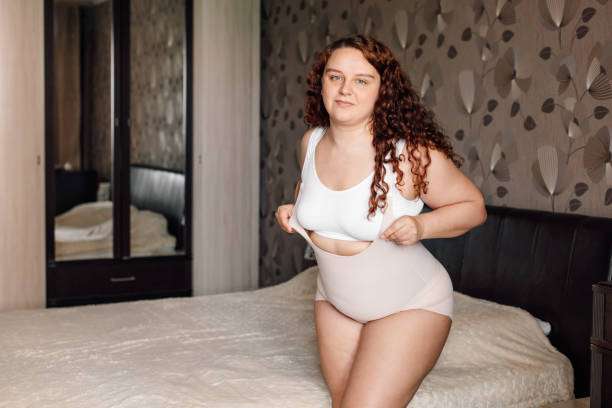
When choosing shapewear, many people focus on the shaping effect, waist and abdomen tightening, and whether it makes them look thinner, but rarely seriously consider a more basic and important question: Will shapewear affect the depth of breathing?
Some people experience chest tightness, shallow breathing, or even unconsciously slow down their breathing when taking deep breaths after sitting or engaging in physical activity while wearing clothing.
Others experience no such sensations at all. This difference is not accidental but closely related to the clothing’s structural design, pressure distribution, and the wearing scenario.
What is “breathing depth”? Why is it important?
Breathing depth, simply put, is the extent to which air enters the lungs with each breath.
Shallow breathing: mainly relies on the expansion of the upper chest cavity.
Deep breathing: The diaphragm moves down fully, and the chest and abdominal cavities work together.
Being in a shallow breathing state for a long time may lead to the following problems:
Easily fatigued, decreased concentration.
Tightness in the neck and shoulder area.
Disrupted breathing rhythm affects relaxation.
When the pressure distribution of shapewear is unreasonable, it often interferes first with the movement space of the diaphragm and lower rib area.
Why might shapewear affect breathing?
Not all shapewear affects breathing, but when the following factors are combined, the probability of breathing depth being affected increases significantly.
1. Abdominal and lumbar pressure directly restricts diaphragmatic movement.
The diaphragm is the core muscle group for deep breathing. When it moves downward, the abdomen needs to make some “room” in areas like:
Upper abdomen.
Lower rib edge.
Above the waistline.
When inhaling, the body will naturally reduce the downward movement of the diaphragm and instead rely on shallower chest breathing.
2. The overall wrapping is too uniform and lacks zoning design.
Some manufacturers, in pursuit of “all-around tightening,” employ an isobaric coating design. The surface appears smooth, but in reality:
Insufficient space for breathing.
The coordination between the thoracic and abdominal cavities is weakened.
Taking a deep breath has become “difficult.”
High-quality shapewear typically provides an elastic gradient in the abdomen and under-chest area, rather than simply being tight all the way down.
3. Slow material rebound speed
Even if shapewear is labeled as “high elasticity,” if the fabric has a slow rebound speed, it can lead to:
Inability to keep up with body expansion during inhalation.
Continued application of pressure after exhalation.
This feeling of being constrained by a “slow response” forces a shortening of the breathing rhythm.
Different types of shapewear have different effects on breathing depth.
Not all shapewear has the same impact on breathing; the key lies in the design objectives.
1. High-waisted
The affected areas are concentrated in the abdomen and lower ribs.
If the tightening intensity is too high, it is most likely to interfere with deep breathing.
Suitable for short-term wear; not suitable for prolonged sitting or standing.
2. Full-body conjoined
The pressure distribution is relatively even.
If the shoulder straps are properly cut below the chest, they will have less impact on breathing.
The key is whether it is designed for “partition compression.”
3. Shaping vests
Less interference with the abdomen.
If the support under the chest is too firm, it may still restrict chest expansion.
It generally has less impact on breathing depth than high-waisted styles.
shapewear on breathing “temporarily” or “long-term”?
This is a question that many people are truly concerned about.
Short-term impact
Breathing restriction is reversible in the following situations:
First time wearing.
The size runs slightly tight.
Sedentary lifestyle.
Upon removing the shapewear, your breathing rhythm will gradually return to normal.
Risks of prolonged improper clothing
If, in the long term, you are
Wearing a size too small.
Wearing it continuously for more than 8 hours a day.
Experiencing continuous restraint during high-frequency states such as work and commuting.
The body may gradually adapt to a shallow breathing pattern, leading to:
Decreased breathing efficiency.
Reduced involvement of core muscles.
It becomes difficult to relax.
This is not a problem with shapewear itself but rather a result of a mismatch between its usage and design.
How can you tell if shapewear is affecting your breathing depth?
You can make a judgment using a few simple self-observation points.
1. Deep Breathing Test
While wearing shapewear, try this exercise:
Inhale slowly for 4 seconds.
Hold your breath for 2 seconds.
Exhale slowly for 6 seconds.
If you feel significant resistance in your abdomen during inhalation, it means the shapewear is applying too much pressure to the critical areas.
2. Physical reactions after prolonged sitting
After sitting continuously for 1–2 hours, observe if:
Do you frequently adjust your sitting posture?
Do you subconsciously shrug your shoulders and breathe?
Do you feel tightness in your chest?
These are all indirect signals of breathing restriction.
3. Respiratory recovery rate after activity
If breathing recovers significantly slower after light walking, it may also be related to shapewear.
shapewear that is more breathable?
If you want to achieve both good posture and comfortable breathing, the following points are crucial.
1. Prioritize the “partition compression” design.
Look for shapewear with:
Support for the waist and abdomen.
Areas under the ribs that retain elasticity.
Designs that do not apply excessive pressure to the chest.
2. Avoid blindly pursuing “extreme tightening.”
Truly effective shapewear doesn’t require you to constantly feel like you’re struggling to breathe. Focus on:
Stable support over extreme compression.
Long-term comfort over short-term slimming.
3. Pay attention to the fabric’s resilience and breathability.
High-resilience fabrics are more likely to follow the rhythm of breathing. A breathable structure can also reduce tension and stuffiness.
Shapewear and breathability are not a matter of “either wear it or don’t wear it.”
When used properly, shapewear is more like a posture aid:
Wear it on occasions where support and embellishment are needed.
Allow your body to move freely during rest, sleep, and relaxation.
Adjust flexibly according to the intensity of daily activities.
In situations where you need to maintain a seated posture for extended periods, choosing breathable shapewear is often more important than simply pursuing a tightening effect.
FAQ:
Q1: Will it cause oxygen deficiency?
Normal, properly sized clothing will not cause oxygen deficiency, but it may make breathing shallower.
Q2: Can I wear it while exercising?
It’s not recommended. Exercise requires a greater breathing range, which may restrict natural expansion.
Q3: Is it because I chose the wrong size if I have difficulty breathing?
This is one of the most common reasons, but it may also be related to the fit and pressure distribution.
Q4: How long should I wear shapewear?
It is generally recommended to wear it for 4–8 hours a day, but you can adjust it flexibly according to your comfort level.
Q5: Does high elasticity always mean it won’t affect breathing?
Not necessarily. Besides elasticity, you also need to consider the rebound speed and the cut structure.
Conclusion:
Truly excellent shapewear should enhance the physique while preserving the body’s most basic freedom of movement, including smooth and natural breathing.
If a piece of shapewear makes you unconsciously shorten your breathing and reduce your willingness to move, then even if it looks ideal, it’s worth reconsidering.
If you are looking for shapewear that balances shaping and breathability, we recommend focusing on zoned design, fabric elasticity, and long-term wear feedback.