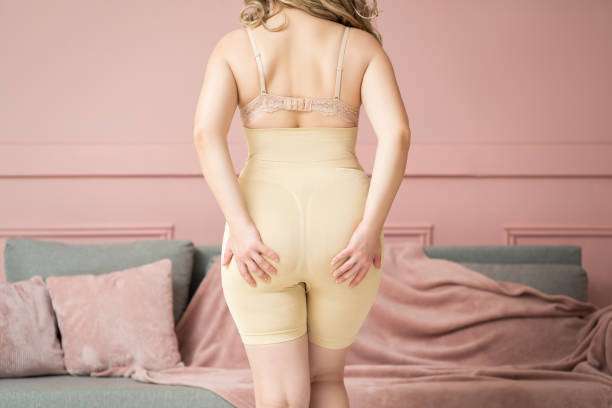
When discussing shapewear, many people’s first reaction is “slimming,” “tummy control,” and “butt lifting.” However, in actual wear and long-term use, what truly determines changes in body shape and comfort is often not the appearance of the shapewear, but whether the pelvis is in a stable and reasonable position.
The pelvis is a core structure connecting the upper body and lower limbs. Its stability not only affects standing, sitting, and walking postures but also influences the stress on the lower back, the distribution of pressure in the abdomen, and even the fatigue felt after prolonged sitting or standing. Shapewear, in its design and stress distribution, is closely related to the pelvic region.

Why is pelvic stability so important?
1. The pelvis is the body’s “stress transfer station.”
The pelvis, located in the center of the body, is a crucial hub for transmitting weight downwards through the spine and force upwards through the lower limbs.
Instability in the pelvic position can lead to:
Lower back fatigue after sitting for a long time
Shift your body’s center of gravity forward or backward when standing.
Uneven force distribution on the left and right sides when walking
Decreased involvement of abdominal and gluteal muscles
These problems are often not obvious, but they accumulate continuously in daily life.
2. Modern lifestyles make the pelvis more prone to instability.
Prolonged sitting, looking down, crossing your legs, and lack of core muscle engagement can cause the pelvis to gradually deviate from a neutral position.
Many people don’t have “bad posture,” but rather their bodies have become accustomed to an unstable pelvic state.
In this situation, shapewear is often worn, but few people really think about
whether it supports or compresses the pelvis.
How does shapewear “come into contact” with the pelvis?
1. It does not only act on the abdomen.
A fully designed shapewear piece typically covers the following areas:
lower abdomen
Both sides of the hip
Near the sacrum
upper edge of the buttocks
These locations are precisely around the pelvic structure.
Therefore, the way shapewear is stressed directly affects the stability of the pelvis.
2. The direction of pressure is more important than the magnitude of pressure.
Many people focus on how tight shapewear is but ignore the direction of pressure.
The pressure that wraps inward evenly helps to provide a sense of stability.
Excessive downward or forward pushing pressure may actually disrupt pelvic positioning.
The shapewear that truly helps with pelvic stability is not single-point pressure but rather wraparound support.
Positive effect on pelvic stability
1. Provide external support to reduce unintentional swaying.
During daily activities, especially when sitting, standing, or walking slowly, the pelvis actually undergoes subtle swaying.
Appropriate shapewear can help during these movements:
Provides light support
Limit excessive forward or backward leaning
Makes it easier for the body to maintain a neutral posture
This feeling of being “supported” often makes the overall posture more effortless.
2. Help the body rediscover its correct position
Wearing shapewear, the body will feel it more clearly:
Is the waist sagging?
Is the pelvis tilted forward?
Is the lower abdomen being used continuously?
This sensory feedback is itself a form of posture reminder.
In some situations, people find it easier to maintain a stable standing and sitting posture even after removing shapewear.
3. Reduce compensatory pressure on the lower back and hips.
When the pelvic position is more stable:
The lumbar spine does not need to overcompensate.
Smoother hip joint movement
Lower back tension reduced
Shapewear is not a “replacement of muscle work,” but rather a way to reduce unnecessary compensation at certain stages.
In what situations might pelvic stability be compromised?
1. Excessive tightening can actually restrict natural movement.
If shapewear is worn in the pelvic area:
Excessive stress
Insufficient material resilience
Long-term continuous high pressure
This could lead to limited pelvic movement, causing the body to seek compensatory pathways in other parts of the body.

2. Designs with an unreasonable center of gravity.
Not all shapewear takes pelvic structure into account.
Some designs only emphasize abdominal tightening, neglecting:
Hip wrap
Sacral support
Transition between lower abdomen and buttocks
These types of shapewear may be visually effective, but they offer limited help in pelvic stability.
Relationship with core muscles
1. It’s not about “letting the core team slack off.”
A common misconception is that wearing shapewear will cause core muscle atrophy.
In reality, the key is not whether to wear it or not, but how to wear it and for how long.
When used properly, shapewear is more like
Provide external prompts
Help establish the correct power generation pattern
Rather than completely replacing muscle work.
2. Pelvic stability affects the overall way you use your strength.
When the pelvis is more stable, the body is more prone to:
Activate the transverse abdominis muscle
Coordinate the use of the glutes and thighs
Reduce lumbar compensation
This is why some people feel their movements are more “integrated” when they are wearing shapewear.
Wearing shapewear for a long time—what does it mean for the pelvis?
1. The key lies in the “phased” and “purposeful” aspects.
If shapewear is used for:
Specific occasions
Specific period
Define your goals (e.g., prolonged sitting, commuting, or standing).
Its effect on pelvic stability is often positive.
Conversely, if used indiscriminately around the clock, the body may gradually become dependent on external support.
2. Physical feedback is more important than changes in appearance.
The signals that are truly worth paying attention to include
Do you feel more relaxed after sitting for a long time?
Is standing more energy-efficient?
Has the tension in your lower back decreased?
Shapewear is properly supporting the pelvis, which is how much thinner one looks.
FAQ:
Q1: Can shapewear really stabilize the pelvis?
A: When properly designed and with even pressure distribution, shapewear can provide external support to help the pelvis maintain a more stable position.
shapewear suitable for people with anterior pelvic tilt?
A: Some styles may be helpful, but it’s important to avoid designs that only emphasize abdominal tightening while neglecting lower abdominal and hip support.
Q3: Will it affect walking posture?
A: Appropriate posture usually makes gait more stable rather than restricting movement.
Q4: Is it suitable to wear when sitting at a desk for long periods of time?
A: Provided that the pressure is not excessive and the material is breathable, some people will find it easier to maintain a sitting posture.
Q5: Can it replace core training?
A: No. It is an auxiliary tool, not the training itself.

Summarize:
Shapewear is never just about “tightening the body.”
When it is understood and used correctly, its real function is to gently guide pelvic stability.
A stable pelvis makes the body work more efficiently and is closer to its natural state.
As the body gradually learns to maintain this stability, changes in external lines become merely a byproduct.
If you want shapewear to not only change your appearance but also provide comfortable and stable support in your daily life,
you might as well start with the structural design, stress distribution, and wearing feedback to choose a style that is more suitable for your body condition.