
shapewear, many people focus on the tightening effect, slimming effect, and comfort. However, the key to determining how long a piece of shapewear can be worn is actually its elasticity and recovery ability.
You may have encountered this situation:
- it fits snugly when you first buy it, but becomes noticeably looser after a few weeks.
- Or after washing it a few times, the shaping effect is much less than before.
This is not entirely a quality issue but rather a genuine difference in how the shapewear elastic system works.
In this article, we will break down the true principles behind the elastic recovery capabilities of shapewear from three aspects: materials, structure, and usage logic.
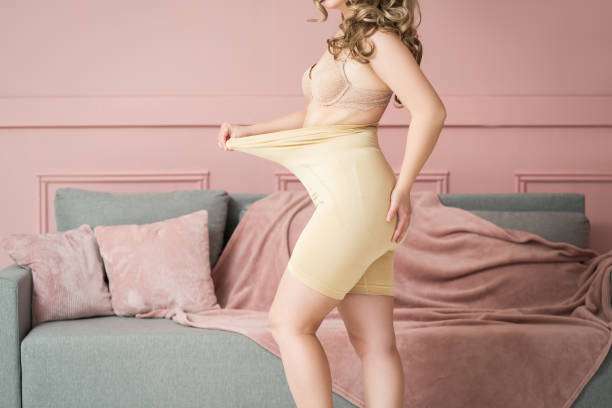
What is the “elastic recovery capability” of shapewear?
Simply put, the elastic recovery ability of shapewear refers to
- After being stretched
- Can it quickly and stably return to its original form?
- It maintains its shaping effect even after multiple wears and washes.
Elasticity ≠ Good elasticity. What
really matters is the cyclical stability of “stretching-rebounding-restretching.”
The core material determines the flexible ceiling
The elasticity of shapewear primarily comes from the fibers themselves.
1. The function of spandex (Spandex / Lycra)
Incorporates a certain proportion of spandex.
- Responsible for tensile strength
- Provide a rebound basis
- Determines the dynamic response that conforms to the body.
However, more spandex isn’t necessarily better.
Too high a proportion can actually have the following effects:
- Increase the rate of fatigue aging
- Reduced long-term stability
often strikes a balance between support fibers and spandex.
2. Supporting fibers are the “skeleton.”
Besides spandex, shapewear also relies on:
- nylon
- High-density polyester fiber
- Special composite yarn
These materials are not very elastic, but they are shape-stable and can “remember the structure” through repeated stretching.
This is why some shapewear doesn’t feel particularly soft, yet it’s more durable.
The weave structure determines whether the elasticity can be sustained.
The same material, different structures, completely different results.
1. High-density knitting vs. regular plain knitting
High-density knitting:
- More uniform elastic distribution
- Localized stress concentration
- Stable rebound speed
Plain weave:
- Initial elasticity is obvious
- Easily leads to localized fatigue
- After using it for a period of time, the feeling of loosening became obvious.
Excellent shapewear often relies on structural design rather than simply being “tight.”
2. The significance of flexible zoning design
Many high-quality shapewear items will be available at:
- waist and abdomen
- hips
- thigh
- back
By using weaving techniques with different elastic moduli, each part can return to its proper position after stretching, rather than the whole thing “collapsing.”

Why does elastic recovery ability decrease?
Shapewear is not consumed in one go, but rather through a process of fatigue accumulation.
1. Prolonged high-intensity stretching
- Sizes run small
- Wearing for too long
- Continuous stress under a high-temperature environment
Both will accelerate the fatigue of elastic fibers.
2. Improper washing is a hidden killer.
Common errors include:
- hot water washing
- drying
- Heavy-duty machine wash
- Use strong alkaline detergents
These behaviors will damage the molecular structure of the fibers inside the shapewear, reducing its resilience.
Why do some shapewear pieces “look fine” but have already failed?
This is a very typical phenomenon:
- No deformation in appearance
- No significant change in size
- But the support disappeared after wearing it.
The reason is that
A decrease in elastic recovery ability does not necessarily lead to a change in appearance.
The fiber can no longer provide sufficient reaction force at the microscopic level, but the macroscopic shape remains intact.
What are the differences in the feel of wearing shapewear with good elasticity recovery?
When the elastic system of shapewear is still healthy, you will clearly feel:
- Stretch and quickly press back onto the body
- No need for frequent adjustments
- Stable posture even after prolonged sitting or activity
- There was no obvious feeling of “being stretched” after taking it off.
This is why some shapewear offers a more reassuring wearing experience, rather than constantly putting pressure on the body.
Elasticity recovery ability ≠ tightness
A common misconception is that
The tighter the fabric, the better the elasticity.
In fact, excellent shapewear often consists of:
- It wasn’t too tight when I first wore it.
- But maintain support throughout the changes in movement.
- It will not become noticeably loose over time.
True elastic recovery means “keeping up with the body,” not “restricting the body.”
FAQ:
- Q1: How long does it usually take for elasticity to decrease?
It depends on the frequency of use and care methods, usually ranging from several months to a year. - Q2: Can elasticity recover after it decreases?
In most cases, it is irreversible; it can only slow down the continued decline. - Q3: Are expensive shapewear pieces always more durable?
Not necessarily, but products with more rational structures and materials usually have better stability. - Q4: How to determine if the elasticity is still normal?
The most intuitive criteria are whether it can fit quickly after wearing and whether it needs frequent stretching and adjustment. - Q5: Does alternating wearing clothes help?
Yes, it allows the fibers enough time to recover and extends their overall lifespan.

Summarize
The true value of shapewear lies not in the firming effect on the first day, but in
- 20th time wearing it
- 50th wash
- Can it still provide stable support?
shapewear that is truly suitable for long-term wear.
Welcome to our curated shapewear collection, where shaping results go beyond just day one.